
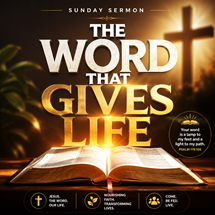
SUNDAY GOSPEL REFLECTIONS: THE WORD THAT GIVES LIVE
The Word That Gives Life (Nya Si Naa Agbe La)
Introduction
Grace to you and peace from God our Father and our Lord Jesus Christ.
Today, we gather under a powerful and liberating theme: “The Word that gives life”—in Eʋe, “Nya si naa agbe la.”
In a world filled with voices that bring despair, anxiety, and spiritual dryness, we are reminded that God’s Word is uniquely different. It doesn’t just inform us; it transforms us. It doesn’t just speak about life; it imparts life. As the Psalmist beautifully declares in Psalm 119:105, “Your word is a lamp to my feet and a light to my path.” When we walk in the dark, the Word gives us the direction we need to survive and thrive.
Let’s see now the Challenge of the Flesh vs. The Life of the Spirit.
The question we will ask is, how does this Word give us life? Our second reading from Romans 8:1-11 draws a sharp contrast between living according to the “flesh” and living according to the “Spirit.”
The flesh represents our human weakness, our brokenness, and our attempts to survive without God. Paul warns that the mind governed by the flesh is hostile to God and ultimately leads to death.
“But you are not in the flesh but in the Spirit, if indeed the Spirit of God dwells in you.” (Romans 8:9)
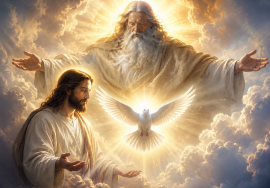
When the Word of God enters our hearts, it brings the Holy Spirit. And the Spirit does something miraculous: He resurrects our dead situations. If Christ is in you, though your physical body is subject to limitations, your spirit is alive because of righteousness. The Word gives life by shifting us from the death-grip of the flesh into the life-giving rhythm of the Spirit.
The Danger of Short-Sightedness.
If the Word gives eternal, vibrant life, why do we sometimes miss out on it? The reading in Genesis 25:19-34 gives us a sobering example in the story of Jacob and Esau.
Esau was hungry, exhausted from the field, and focused entirely on his immediate, physical need. When Jacob offered him a bowl of stew in exchange for his birthright, Esau reasoned, “Look, I am about to die; so what profit is this birthright to me?”
Esau traded a permanent, generational blessing—a life-giving inheritance—for a single, temporary meal. He chose the flesh over the promise. When we ignore God’s Word for immediate gratification, comfort, or worldly compromise, we behave like Esau. We trade the “Word that gives life” for things that fade away.
Receiving the Word to Bear Fruit.
This brings us to the core of how we must respond today, found in the Gospel of Matthew 13:1-9, 18-23—the Parable of the Sower.
Jesus explains that the seed is the Word of God. The seed itself is perfect; it has the inherent power to produce life. However, the outcome depends entirely on the soil—which represents our hearts.
Some hearts are like the path: hardened, and the enemy steals the Word away.
Some are like rocky ground: emotional at first, but without root, they wither when trouble comes.
Some are like thorny ground: choked by the worries of this life and the deceitfulness of wealth.
But thank God for the good soil! Jesus says the good soil represents the one who hears the Word and understands it. This is the person who allows “Nya si naa agbe la” to sink deep into their soul, producing a harvest of thirty, sixty, or a hundred times what was sown.
Conclusion.
Brothers and sisters, the Word is being sown today. It is a lamp for our dark paths, a Spirit that quickens our mortal bodies, and a seed of eternal inheritance.
Let’s not be like Esau, trading our spiritual life for temporary pleasures. Do not allow the worries of this world to choke the seed. Instead,let us open our hearts today. Let the soil of your hearts be soft, receptive, and obedient.
Receive the Word. Let us live by the Word. Because it is truly the Word that gives life.
May the Spirit of Him who raised Jesus from the dead dwell in you richly and give life to everything you do.
Amen.