


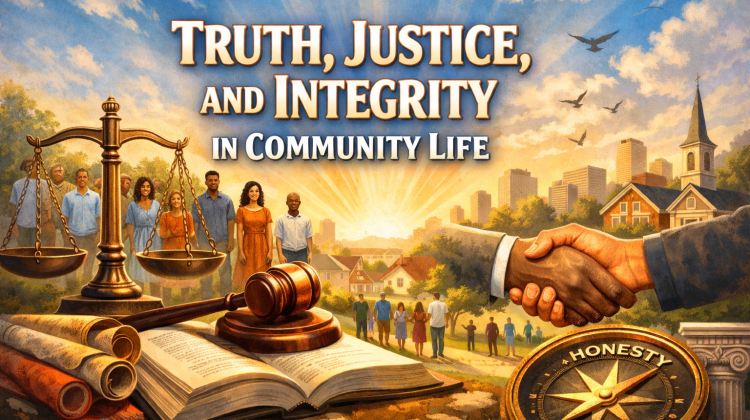
Truth, Justice, And Integrity In Community Life
A Reflection on Exodus 23:1
“You shall not spread a false report. You shall not join hands with a wicked man to be a malicious witness.” (Exodus 23:1, English Standard Version)
Exodus 23:1 belongs to a body of laws given by God to the people of Israel shortly after the delivery of the Ten Commandments. These instructions were intended to mould Israel into a community marked by justice, holiness, and reverence for God. They emphasised moral responsibility, accountability, and respect for one another, particularly in matters of speech, testimony, and justice. At the heart of this verse lies God’s deep concern for truth, integrity, and fairness in communal life.
In today’s world, where rumours, misinformation, propaganda, and false accusations spread rapidly—often amplified by digital and social media—this ancient biblical command remains remarkably relevant. Its message transcends religious boundaries and speaks to all who long for societies built on trust, justice, and respect for human dignity.
“You shall not spread a false report”
The first part of Exodus 23:1 addresses the ethical responsibility of speech. A false report includes lies, rumours, half-truths, exaggerations, unverified claims, and deliberate misinformation. The command does not only prohibit the invention of falsehood but also forbids its transmission. In other words, moral responsibility extends beyond the original speaker to everyone who chooses to repeat or circulate untruths.
From a theological standpoint, Scripture consistently affirms that God is a God of truth who does not lie (Numbers 23:19). Falsehood, therefore, contradicts God’s very nature. When truth is distorted, trust within families, institutions, and communities is eroded, often leading to suspicion, division, and social breakdown. Lies do not merely misinform; they damage relationships and weaken the moral fabric of society.
In practical and social terms, individuals are called to exercise discernment and restraint in how they speak. This applies especially to gossip and hearsay, careless social media engagement, and the repetition of unverified information often introduced with phrases such as “I heard” or “they said”. In many situations, choosing silence when facts are unclear is not cowardice but a moral and spiritual act of obedience. Responsible speech nurtures peace, protects reputations, and promotes social harmony. Scripture strongly reinforces this call, warning that God detests a lying tongue (Proverbs 6:16–19) and urging believers to put away falsehood and speak truthfully to one another (Ephesians 4:25).
“You shall not join hands with a wicked man”
The second clause shifts attention from speech to association and complicity. To “join hands” implies cooperation, agreement, or active participation. The verse warns against aligning oneself with individuals or groups who employ deceit, manipulation, or falsehood to harm others or achieve unjust ends.
Morally and spiritually, this teaches that wrongdoing often thrives not only through active perpetrators but also through collective participation, silent approval, or passive complicity. Integrity demands the courage to resist peer pressure and to refuse involvement in actions that contradict truth and justice, even when such resistance is socially costly or unpopular.
In contemporary contexts, this command challenges individuals not to support false accusations, character assassination, mob justice, or trial by public opinion. It also speaks against participation in corrupt systems and unethical practices that normalise deceit. True moral courage is demonstrated when individuals are willing to stand apart and uphold truth, even when the majority chooses otherwise. Biblical wisdom echoes this warning, advising against walking in the counsel of the wicked (Psalm 1:1) and cautioning against partnerships that compromise righteousness (2 Corinthians 6:14).
“To be a malicious witness”
The final phrase of Exodus 23:1 addresses intent, consequence, and justice. A malicious witness is someone who knowingly gives false testimony with the intention of harming another person. Such behaviour weaponises speech and strikes at the very heart of justice. When lies are used deliberately to destroy reputations, deny fairness, or inflict punishment, the foundations of justice are severely undermined.
In ancient Israel, witnesses played a decisive role in legal proceedings. False testimony could result in grave injustice, including wrongful punishment or even death. For this reason, God’s law treated malicious witnessing as a serious moral offence, with strict consequences attached to it (Deuteronomy 19:16–20). Justice, according to biblical ethics, must always be protected from distortion and abuse.
From a New Testament perspective, Jesus Christ Himself became a victim of malicious witnesses during His trial (Matthew 26:59–60). His crucifixion stands as the ultimate revelation of how institutionalised falsehood can lead to profound injustice. The cross exposes the destructive power of lies and underscores the urgent need for truth in both personal and public life.
Contemporary Relevance
In modern society, false reports often travel faster than verified truth. Innocent individuals are frequently judged and condemned in the court of public opinion long before facts are established. Truth is sometimes sacrificed for personal advantage, political ambition, financial gain, or revenge. Exodus 23:1 therefore speaks powerfully to people of all backgrounds, calling them to speak responsibly, act courageously, and stand firmly for justice. A society that values truth is one that protects human dignity, fosters trust, and sustains social stability.
Christological Reflection
From a Christian perspective, Jesus Christ embodies truth itself (John 14:6). He is the righteous Judge and yet the innocent One who was condemned by lies so that humanity might be justified through truth. Those who follow Christ are therefore called to reflect His character by living lives marked by truthfulness, integrity, and justice in both word and deed.
Conclusion
Exodus 23:1 teaches enduring moral principles that remain vital for every generation. Truth is not optional; it is a moral obligation. Silence in the face of falsehood can become a form of complicity, while integrity is essential for healthy communities and just societies. Upholding truth requires courage, discipline, and moral clarity.
Final Exhortation
Let us strive to be people who speak truth, resist unethical alliances, and refuse to participate in injustice, even when doing so demands personal sacrifice. In upholding truth, we contribute to peace, justice, and the common good of our communities and the wider world.
Closing Prayer
Lord God of truth and justice, guard our tongues, purify our hearts, and strengthen us to stand for what is right in a world filled with falsehood. May we neither spread lies nor join hands with wickedness, but reflect Christ, who is the Truth. Amen.
Rev. Sylvanus Yao Kpodonu (SKY)
References
The Holy Bible, English Standard Version. (2001). Crossway.
Brueggemann, W. (2008). Theology of the Old Testament: Testimony, dispute, advocacy. Fortress Press.
Childs, B. S. (2004). The Book of Exodus: A critical, theological commentary. Westminster John Knox Press.
Wright, C. J. H. (2004). Old Testament ethics for the people of God. InterVarsity Press.









May God help us to be loyal to one another in society. Honesty should be the hallmark.